Longfellow
Nokomis
Nokomis
News for everyone, delivered to everyone
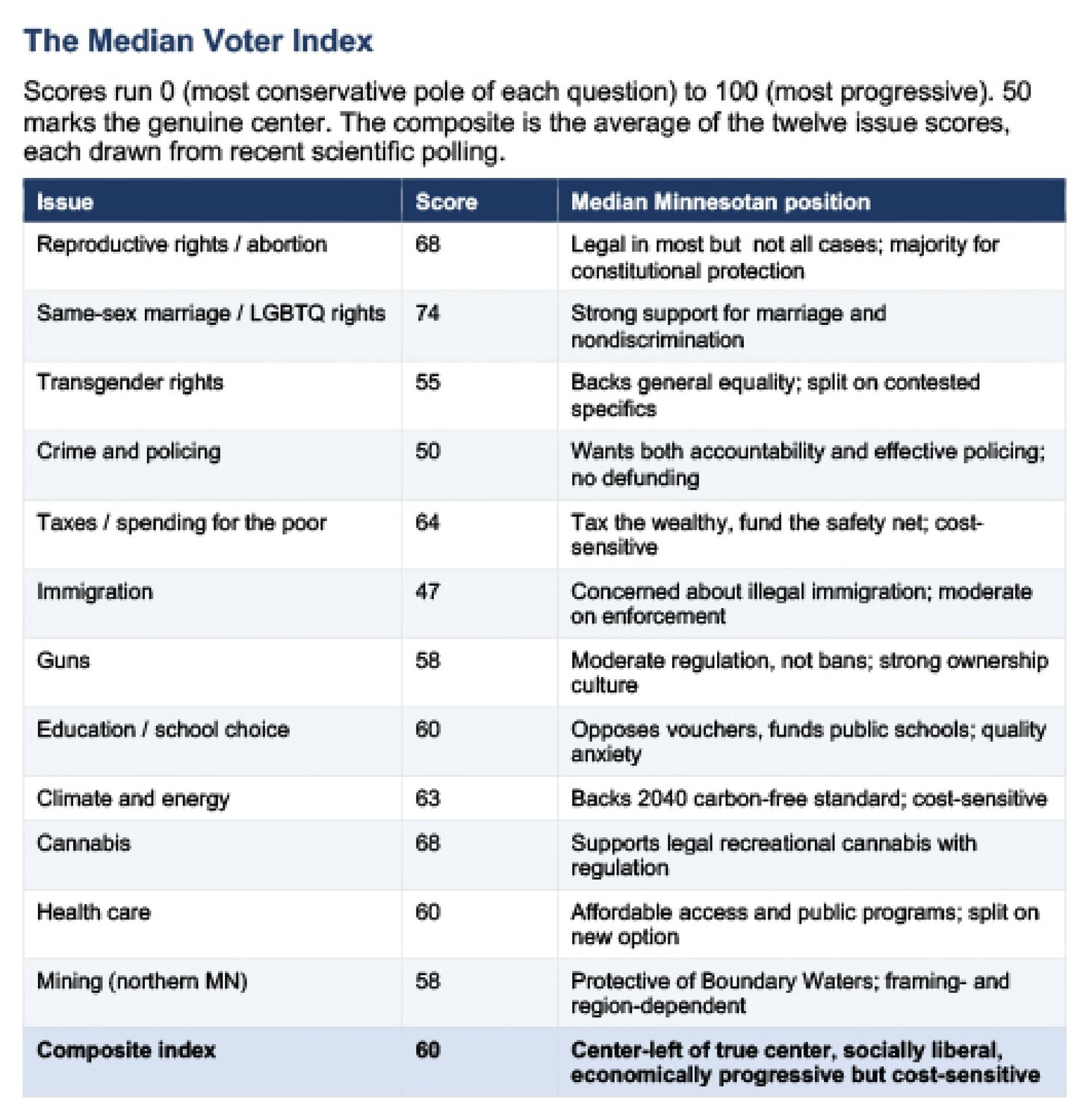
When Minnesota's two major parties gathered at their endorsing conventions the last week of May, the activists in the room were not a cross section of the state. They were the most committed, the most ideological, and the most willing to give up a spring weekend to argue about platform planks. That is exactly why the positions they crafted drift away from where the average Minnesotan actually stands. I recently built an index of the median Minnesota voter, scoring twelve contested issues on a zero to one hundred scale from recent polling, where zero is the most conservative position and one hundred the most progressive. The median voter lands at about 60: modestly left of center, but nowhere near either party's base.
That median Minnesotan is easy to describe. This is someone who believes abortion should stay legal, supports same sex marriage and nondiscrimination protections, backs legal cannabis, wants higher taxes on the wealthiest earners and a strong safety net, and supports the transition to clean energy. At the same time, this voter feels real strain from the cost of groceries, gas, and housing, treats illegal immigration as a genuine concern, wants both effective policing and police accountability without anything resembling defunding, prizes the Boundary Waters enough to resist copper nickel mining nearby, and is genuinely unsure about the most contested transgender policies. In short, progressive on rights and the environment, anxious but progressive on taxes and spending, and stubbornly centrist on the law and order and identity questions where the state is most evenly split. The full index is below.
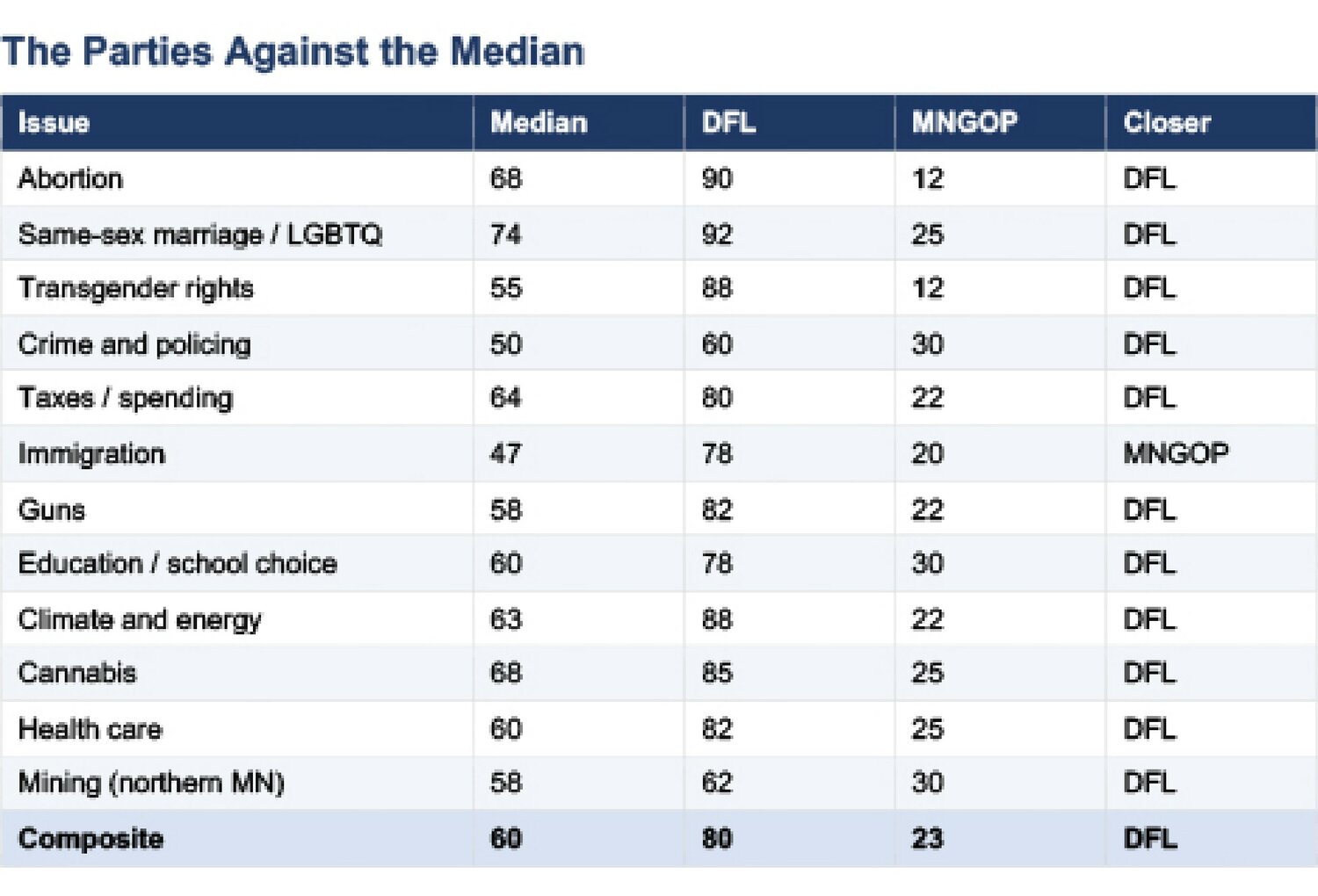
Neither party speaks to that whole person. The Minnesota DFL, scored the same way, comes in around 80. On the issues where Minnesota leans liberal, the party is directionally right but simply louder, holding the position the majority already holds and pushing it further. Its 2023 to 2024 trifecta delivered a generation of policy in a single biennium: codified abortion rights, legal cannabis, a 2040 carbon free electricity standard, expanded background checks and a red flag law, free school meals, paid leave. Much of that tracked majority sentiment. But the party also ran ahead of the median on the harder questions, pressing the most expansive transgender policies, a sweeping new government health insurance option, and a reform posture on policing that the average voter never embraced. When you govern from 80 in a state whose center sits at 60, you win the big statewide races and then watch your legislative majorities evaporate. The 67 to 67 tie in the Minnesota House after 2024 is what a 20 point gap looks like in practice.
The Republican Party of Minnesota has the opposite and far larger problem. Scored against the same median, the MNGOP comes in at roughly 23. That is not 20 points from the center. It is about 37 points, nearly twice the DFL's distance, and it sits on the wrong side of issue after issue where Minnesotans have made up their minds. The party's platform calls for overturning the state and federal decisions protecting abortion, eliminating abortion funding, accommodating religious refusals of service to gay and lesbian customers, opposing recreational cannabis, and rolling back the clean energy mandate. Each of those positions puts the party against a clear Minnesota majority. A voter at 60 looking at a party at 23 does not see a reasonable alternative with different priorities. They see a party arguing about things the state settled years ago. The table and chart below place all three side by side.
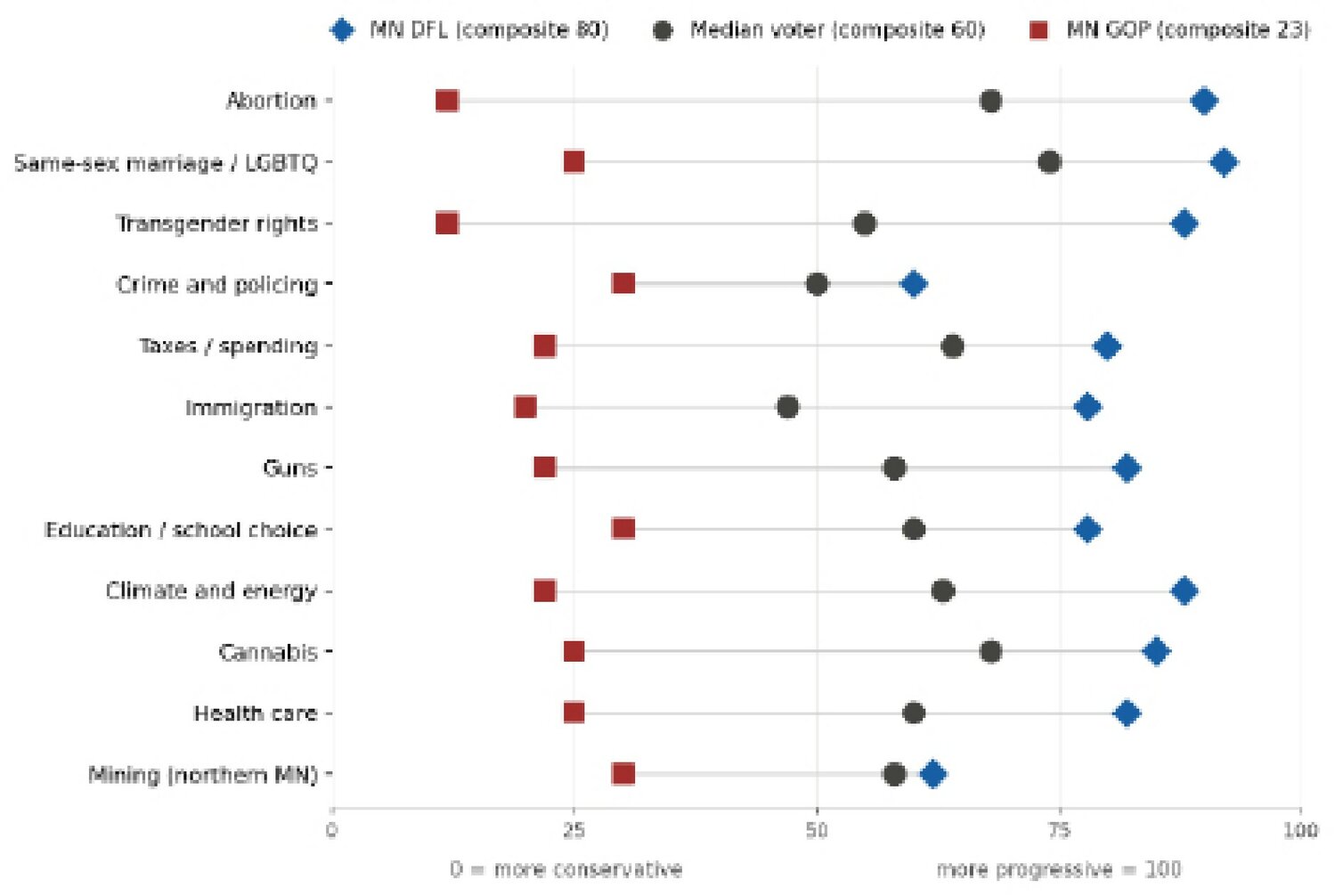
This is the real explanation for a statistic that ought to alarm Republican strategists: no Republican has won a statewide election in Minnesota in roughly two decades. It is the longest such drought of any state in the country. The standard excuses, candidate quality, national headwinds, the metro's growth, all contain some truth, but they miss the structural fact. You cannot win a state from 37 points out. The median voter is reachable for Republicans on exactly two dimensions, and they are not small ones. On taxes and spending, the average Minnesotan's genuine sensitivity to cost of living and personal tax burden gives the party a real opening. On immigration, the median voter's concern about illegal immigration aligns more with Republican framing than with the DFL's expansive posture on benefits and licenses. A party disciplined enough to lead with affordability and border concerns while quietly setting aside its losing fights on abortion, marriage, and climate could compete. The convention delegates will not let it.
And that is the deeper point, the one that applies to both parties. The endorsing convention is a machine for amplifying the base and punishing the center. DFL activists pull their party toward 80; Republican activists pull theirs toward 23 or lower. Neither group is built to ask what the voter at 60 actually wants, because that voter is not in the room and rarely shows up to a caucus. The result is two parties whose official platforms are documents written for the faithful, not the electorate. The median Minnesotan, offered a choice between a party 20 points to the left and a party 37 points to the right, does what the data shows: leans reliably Democratic at the top of the ticket, because that is the shorter distance, while keeping the Legislature close and refusing to hand either side a durable mandate.
There is a lesson here that neither convention wants to hear. Minnesota is not a deeply progressive state, nor a closet conservative one. It is a center left state with a pragmatic streak, protective of rights and the environment, worried about its wallet, and impatient with extremes. The party that figures out how to govern from 60 instead of campaigning from its base will dominate Minnesota politics for a generation. So far, the DFL has come closer by accident of proximity, and the GOP has not come close at all. Until the activists who write the platforms make peace with the voters who decide the elections, the gap between the convention hall and the kitchen table will keep deciding who wins.
A note on the numbers
The median voter scores are coded from recent scientific polling: the MinnPost/Embold Research statewide polls, the Star Tribune/MPR News/KARE 11 Minnesota Poll, the PRRI American Values Atlas, Data for Progress polling on the 2040 clean energy law, and related sources, with a large but nonscientific Minnesota House State Fair poll used only as directional context. The party scores are coded from the Minnesota DFL Action Agenda and the party's 2023 to 2024 governing record, and from the Republican Party of Minnesota platform and recent legislative positions. The platform language reflects the most recently adopted MNGOP platform, supplemented by current legislative priorities. All scores place majority and plurality positions onto a common 0 to 100 scale and are intended as a transparent, revisable framework rather than a definitive measurement.
David Schultz is Distinguished University Professor in the Departments of Political Science, Environmental Studies, and Legal Studies at Hamline University. He is also an adjunct professor of Law at the University of Minnesota and at the University of St. Thomas, and an affiliate faculty member at the Lithuanian Military Academy in Vilnius, Lithuania. A four-time Fulbright scholar who has taught extensively in Europe and Asia, and the winner of the Leslie A. Whittington national award for excellence in public affairs teaching, David is the author of more than 45 books and 200+ articles on various aspects of American politics, election law, and the media and politics, and he is regularly interviewed and quoted in the local, national, and international media on these subjects including the New York Times, Wall Street Journal, Washington Post, the Economist, and National Public Radio. His most recent books are Constitutional Precedent in US Supreme Court Reasoning (2022), Handbook of Election Law (2022), and Presidential Swing States (2022). Prior to teaching, Professor Schultz served as a city director of planning, zoning and code enforcement, and as a housing and economic planner for a community action agency. David is on the ACS Minnesota Advisory Board and is former executive director of Common Cause Minnesota and a former vice-president for the Minnesota and South Texas chapters of the American Civil Liberties Union. He is licensed to practice law in Minnesota and before the US Supreme Court.
This piece originally appeared at Minneapolis Times, where Schultz is editor in chief.


1 comment on this item Please log in to comment by clicking here

saxner
Let's change from caucuses/conventions to primaries. The former are elitist in that they cater to those who can afford childcare, transportation, who aren't working nights/weekend, etc. Primaries allow everyone to participate and provide a much better representation of constituents.
Saturday, August 29 Report this